

TL;DR
A median-paid software developer in the US costs about $198,500 a year once benefits and payroll costs are added (BLS data for 2025–2026), and filling the role usually takes a month or more. A dedicated outsourced engineer from our team in Ukraine costs about $4,800–5,600 a month and can start within two weeks. Keep development in-house when software is your core product and you can hire and lead engineers well; outsource when you need speed, flexibility or skills you do not have. Whichever you choose, own your code, accounts and access from day one, so you can change course at any time.
Make a summary of this article with AI:

“Should we hire our own developers or outsource?” is one of the first questions founders and managers ask us. I have seen it from both sides: I used to recruit engineers for US companies, and for many years I have run Intobi, a software development company with a team in Ukraine. This guide compares the real costs, the time it takes to get someone working, the risks and the red flags, with stories from our own clients.
What would your project cost with our team?
Pick a project type and see a price range and timeline based on our real hourly rates.
Outsourcing vs in-house at a glance
| In-house developer (US) | Outsourced dedicated engineer (Intobi) | |
|---|---|---|
| Cost of one developer | About $16,500 a month at the US median, with benefits and payroll costs | About $4,800 a month (middle) or from $5,600 a month (senior) |
| Time to get started | A month or more to fill the role, then a couple of weeks of paperwork | A candidate in one to two weeks; work starts within two weeks of signing |
| Control | Your employee, your tools | Works only on your product, in your repository, tracker and cloud |
| Scaling up or down | Slow; hiring and letting people go are costly | Add or remove people month by month (minimum one person for two months) |
| Paperwork | Employment contracts, payroll, benefits, equipment | Two documents with the vendor: an NDA and a development agreement |
| Main risk | A wrong hire and keeping good people | A wrong vendor (see the red flags below) |
What an in-house developer really costs in 2026
The median software developer in the US earned $135,980 a year in May 2025, according to the US Bureau of Labor Statistics. Salary is only part of the cost: in private industry, benefits make up 31.5% of total compensation for management and professional workers, BLS employer cost data for June 2026 shows. Add them back, and one median-paid developer costs about $198,500 a year, or about $16,500 a month, before recruiting, equipment, software licenses and the time your managers spend on hiring.
| Cost per month | What it includes | |
|---|---|---|
| In-house developer in the US (median) | About $16,500 | Salary, benefits and payroll costs; recruiting, equipment and office not included |
| Intobi middle developer | About $4,800 | 160 hours at $30/hour on average |
| Intobi senior developer | From $5,600 | 160 hours at $35/hour and up |
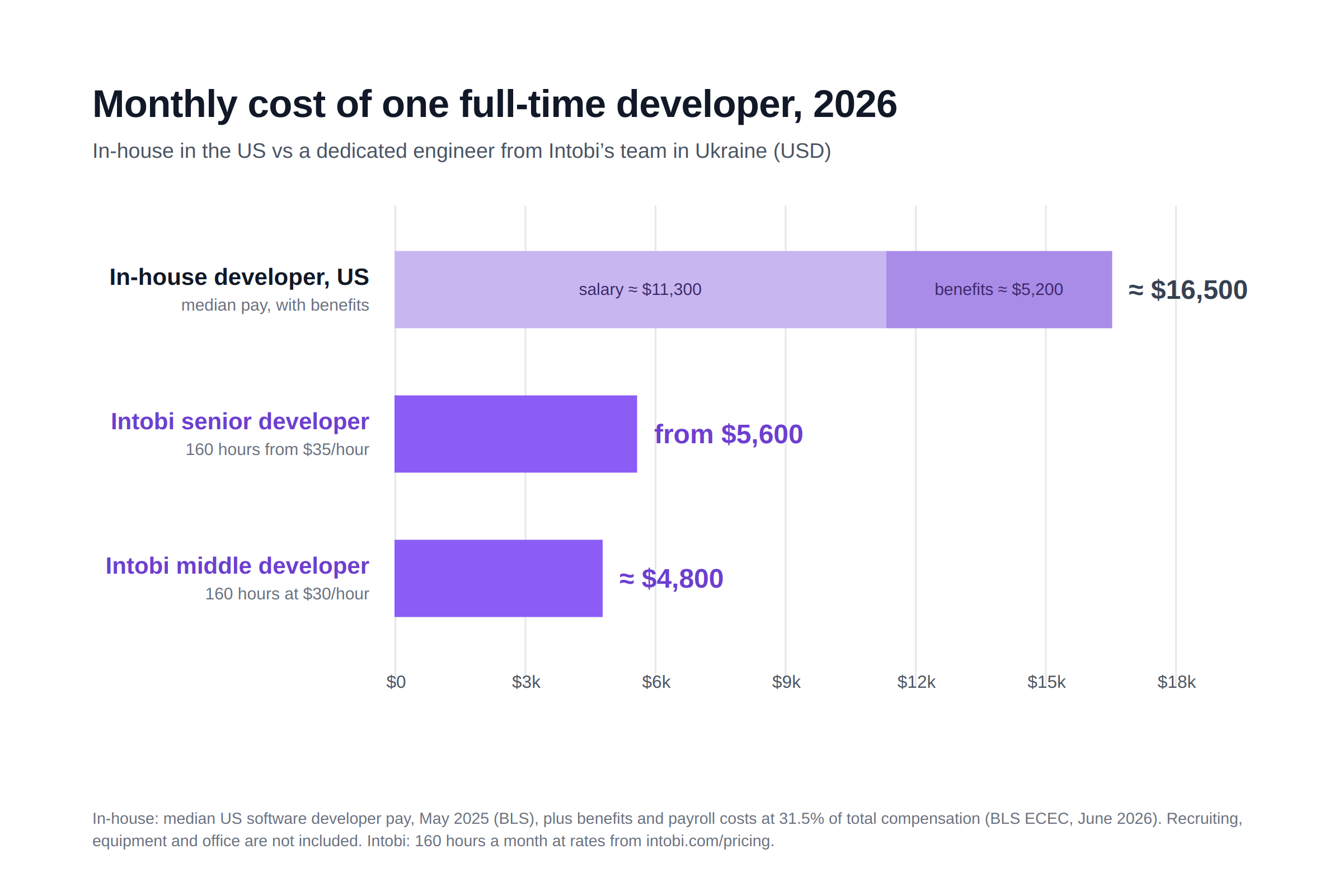
The comparison is not perfectly like-for-like: the BLS median covers all US developers, and an outsourced engineer still needs clear goals from your side. Even so, the gap is big enough that cost alone rarely decides. Time, control and trust do. For rates in other countries, see our software development rates by country, and for our own prices, the pricing page.
How long it takes to get a developer working
Before Intobi, I worked as a recruiter for American companies and was paid $35 an hour for my recruiting time. I had to go through a very large number of engineers before I found a good candidate. On average it took at least a month to close a position, and then a couple more weeks before the engineer started, because both the company and the engineer had a lot of paperwork to do.
In Ukraine I usually find the right candidate within one to two weeks, and work can start in a couple of days after that. The paperwork is simple for the client: they sign one agreement with us, and all the hiring and payroll work with the engineer is on our side, done under Ukrainian law. Before the engineer starts, the client interviews them. If the person does not fit, we replace them quickly, at our own risk and cost.
When in-house is the better choice
Outsourcing is not always the answer. Building an in-house team usually makes more sense when:
- software is your core product and its know-how is what you sell;
- you already have engineering leaders who can hire, review and mentor developers;
- the workload is steady and will stay so for years;
- your rules require employees, not contractors, to work on certain systems.
Even with a good outsourcing partner, moving people in-house can be the right ending. At Intobi, after five years of working together, a client can hire an engineer directly for a fee, if everyone agrees and the contract provides for it. We have done this several times, to thank both the client and the engineer for stable, good work.
Sometimes you just need to say thank you and let people work directly. It builds trust, and in the end the client comes back to us for more work or recommends us to friends.
Andrew Tsopych, CEO of Intobi
When outsourcing works better
Outsourcing usually wins when you need a skill you do not have, need to start quickly, are not sure how much work there will be, or want to test a partner on a small task before committing. That is how our longest client relationship started.
From a 100-hour task to eight years of work
Eight years ago, a large enterprise company came to us with a design task of about 100 hours. They had strict data protection rules, and their manager was against outsourcing. But they had no designer at the time, so they posted this short task on Upwork. We did the design at a good price, without our usual margin: showing good work mattered more than earning on it.
Next, they asked us to build the front end of those pages, another short task of about 200 hours, and again we did it quickly and almost at cost. Then we signed an NDA, and the client asked for a developer for a trial month. We could see they were worried about risk and security, so we explained how it would work: a dedicated developer who works only on their project, joins every call with the camera on, writes a plan for the day every morning and an update on the work done every evening.
The month went well, and the client continued. Two years later they hired a second full-time engineer from us, and the same two engineers work with them today. Over all these years the client raised two or three concerns, and each time we reacted and fixed what needed fixing. Later the client paid for security courses for both engineers and gave them computers with licensed software, so everything stays under their control. In two years we will celebrate ten years together.
For a few more stories about long-term work, see our guide to software development rates.
Extend your team or hand over the whole tech side
Outsourcing is not one model. We see two common setups:
- You hand over the technical side. Your job is to set the business goal. We work out the details of the task, build it, deploy it to the servers and support it. Our dedicated development team page explains how this works.
- You extend your own team. Our engineers join your team, follow your processes and work with your people respectfully, like any colleague. This is IT staff augmentation.
How you pay is a separate choice: fixed price, time and material, or a monthly team. Our engagement models guide compares them.
The biggest fear: paying senior rates for junior work
The fear we hear most often is dishonest work: that a vendor will sell a junior at a senior’s price, or that the developer will quietly work on other projects too. This is how we remove it in practice:
- One developer, one project. A dedicated engineer works on one client’s project at a time, and the client has exclusive, direct access to them.
- Visible work. Our engineers speak good English, keep the camera on in calls, and write a plan every morning and an update every evening.
- You own everything. The client is the primary owner of all code and knowledge. We work in the client’s own repository, task tracker, Figma and AWS or Azure account, not in ours.
- Two documents. Every client signs an NDA and a software development agreement that sets the team, timeline and budget.
It usually takes a few weeks to earn a client’s trust. After that, clients stay with us for a long time and recommend us to people they know.
We can sometimes make a technical mistake or not know at first how to build something, and then we fix it. But we never give anyone a reason to doubt that our work is honest and transparent. That is the key to working together.
Andrew Tsopych, CEO of Intobi
If your concern is working with a team in Ukraine specifically, including power outages and time zones, our page on software development outsourcing to Ukraine answers it.
If your previous vendor let you down
By my estimate, at least half of the clients who come to us have had a bad experience with another team. We are not afraid of that. We go through the existing code, infrastructure and business logic, run an audit and tell the client honestly what is done well and what needs to improve. Then we improve it and continue the work.
We always tell the truth, even when it does not help us win the project. If the client thinks the previous team did a bad job but the work is actually good, we say so.
Red flags when choosing an outsourcing partner
These are the signs of a vendor I would not work with:
- it keeps processes tied to itself instead of working in the open;
- it holds the code back until the client pays;
- it makes the code or architecture more complex than needed, so no other team can take over;
- it keeps the server keys or owns your business accounts: hosting, Cloudflare, AWS, OAuth apps and so on;
- it raises prices once you depend on it;
- it moves your dedicated engineer to another project because someone offered a higher rate.
We do not sell only programming skills. We sell stability, and we act as partners who care about the client’s business, not only about money. The client’s success is our success, and that is what makes a long partnership work.
Andrew Tsopych, CEO of Intobi
Can you bring development in-house later?
Yes, and it should be easy. From the first day, we set up the work so that the client is the primary owner of everything. If a client wants to leave, they can do it in a day, because they already own the code, the servers and all access. Our team only hands over its knowledge of the system and explains the details of the project, so the new team can continue productively.
This has happened more than once. We never pressure a client to stay: the client should work with us because they want to and because we are professionals, not because they cannot leave. Clients remember this, and they write to us again when they need help.
A checklist before you decide
- Is the software your core product, or a tool that supports your business?
- Do you have someone who can hire, review and lead engineers?
- How soon do you need people working?
- Will the workload stay steady for years, or change from month to month?
- Will you own the code, cloud accounts and access from day one?
- Can you start with a small, paid task to test the partner before a bigger commitment?
If you are building something specific, such as a custom CRM, compare what an internal team would need with a custom CRM development partner, and estimate the budget with our cost calculator.
If you want to try outsourcing, you can always try it with us. We will set up clear, transparent and effective work, where you know everything that happens, what we do and why. With time, you decide whether to stay with us or continue on your own. From experience, when a client comes to us, in nine cases out of ten they stay for years.
Andrew Tsopych, CEO of Intobi
Start with a small task and see how we work
Get an estimate
FAQ
Is outsourcing software development cheaper than hiring in-house?
How long does it take to hire an in-house developer compared with outsourcing?
How do I protect my code and data when I outsource?
Can I hire an outsourced developer directly later?
What if I want to switch vendors or move development in-house?