


Logistics has become more than the simple transport of goods to their destinations in the modern business world. It constitutes a complicated system and entails supply chain control, route control, warehouse control, and real-time tracking of orders.
Enterprises cannot be competitive without the use of modern technologies and tools, particularly in the global markets and in the context of high customer demands.
Software solutions for logistics automate the routine processes, save on costs, and enable you to make quick responses to changes. The use of logistics technology solutions provides transparency in all the stages of delivery and establishes a stable basis for business growth.
What are logistics software solutions?
Logistics management solutions are dedicated programs created to control, manage, and optimize the entire lifecycle of the delivery and storage of goods.
These programs assist companies in arranging their work from the time an order is placed in the company’s hands to the delivery of the goods to the customer. In such a way, these processes are transparent, fast, and cost-effective.
What is the primary concept of logistics management systems? The automation of routine work and the minimization of the probability of human error.
The system assumes the role of route planning, warehouse tracking, and order tracking, instead of having to manually perform all of those tasks. This enables managers to concentrate on business development and strategic activities. in commensurate measure.

The typical key functions of a logistics solution are:
- Transportation management systems (TMSs)
In fact, TMS covers route optimization, control of the transportation cost, and real-time cargo tracking. They help businesses reduce shipping expenses and improve delivery reliability.
- Supply chain management (SCM)
Supply chain management logistics software helps plan demand, coordinate suppliers, and manage procurement. All this is about effective supply chain management as a whole.
- Warehouse management systems (WMSs)
These warehouse systems are about inventory control, positioning of goods, receiving, and shipping processes.
- Analytics and reporting
The information includes the efficiency of transportation, costs, and customer service speed.
With the help of these tools, companies can control every step of the logistics and react quickly to unforeseen changes. For example, when a particular route is congested or when there is a hold-up at customs, the system will automatically propose a different delivery solution.
Besides saving money and time, software solutions for logistics assist in enhancing the degree of service. Customers would demand transparency and fast responses, and being able to scan a parcel online or view delivery times would make them more loyal.
Key benefits of logistics software solutions
The utilization of contemporary logistics enhanced solutions provides firms with a visible competitive edge. Its core worth resides in the fact that they ensure that all processes are easier, transparent, and cheaper.
To begin with, such systems save a lot of money. Planning of routes is automated to save fuel, time, and human resources. A smaller number of errors translates to fewer financial losses.
Secondly, they guarantee speed and precision of delivery. Due to the real-time tracking, companies are able to manage the goods movement and react promptly to any changes. It is more relevant to those businesses in which large quantities of orders are placed.
Another strength is improved inventory control. The integration with warehouse systems gives you an opportunity to learn the current information about the availability of goods, prevent shortages or surpluses, and plan purchases more efficiently.
Better communication is no less important. The supply chain, including carriers, customers, and all participants, gains access to real data, thereby minimizing misunderstandings and enhancing trust levels.
The systems also offer analytics and reporting to aid in making sound business decisions. Managers receive an in-depth view of the expenses, productivity, and efficiency of the whole logistics process.
Finally, the software solutions for logistics establish the circumstances of scaling the business. The company is able to serve more orders easily without raising expenses in commensurate measure.
Top logistics management solutions in 2026
In the year 2026, the logistic software market provides some high-end software that assists companies in efficiently managing their supply chains, warehouses, and transportation.
The following are the top solutions:

- Blue Yonder AI (artificial intelligence) and ML (machine learning) solutions in demand, warehouse and transportation optimization.
- SAP SE A powerful enterprise resource planning (ERP) system of big international companies.
- Oracle SCM Cloud An analytics and visibility cloud supply chain solution in real time.
- Manhattan Associates WMS and omnichannel logistics-related solutions, particularly in the retail and FMCG industries.
- MercuryGate TMS Multiple modes transportation service, analytics, specific requirement customization.
- Descartes Global network solutions, customs, and transit.
- Magaya Supply Chain Forwarding solutions, document management, warehouse, costs, and movements integration.
Why is Intobi a unique choice compared to other companies?
Intobi is a software developer that provides custom SCM, TMS, and other logistics solutions. What sets Intobi apart?
Individual approach: Transport and logistics software are completely tailored to business processes, company requirements, scale, and industry peculiarities.
Complete development cycle: Audit and analysis, design, development, testing, and support.
Technological expertise: Intobi has embraced the use of modern technologies, which will enable it to deliver logistics management software development solutions that are sustainable, scalable, and future-change-ready.
Competitive price: This is relatively competitive, with an emphasis on cost savings without compromising quality.
Good support and flexibility: The company develops a program and continually adjusts the system to new circumstances, including business development, new needs, and integrations.
Case study: Auto Nagel
Speaking of real-life examples in logistics software projects, Intobi collaborates with the German company Auto Nagel. The mission was to develop a SaaS platform that integrates eCommerce, logistics management, document management, and drivers.

Our solution for Auto Nagel
Logistics and driver activity tracking modules, an eCommerce platform, and user roles, built-in accounting, and a powerful document designer.
Outcome of our work
The efficiency of operations has increased, fewer mistakes in documents have been eliminated, convenient drivers and integration of business processes.
How to choose the right logistics software for your business
Selecting logistics management software solutions is a strategic move that influences the effectiveness of all the business processes. To avoid a wrong step and invest in the correct solution, several important steps should be followed.
1. Define your needs and goals
Before asking what the system is to solve, you must know what products it will solve. It may be transport management, warehouse management, document management or full supply chain control. Well-explained objectives will enable you to settle on a solution that will actually work.
2. Consider the size of the business
Small businesses just require straightforward and less costly solutions, whereas medium and large corporations would be much better to invest in scalable systems with extensive functionality.
3. Check integration facilities
The contemporary logistics operations are impossible without communication with CRM (сustomer relationship management), ERP or eCommerce systems. The logistics software solution implemented should be readily compatible with the available systems to eliminate duplication of data and manual labor.
4. Pay attention to ease of use
The most sophisticated transport and logistics software will not work in case it becomes hard to learn among staff. A convenient interface, transparent functionality, and team training to a high standard are the obligatory success requirements.
5. Consider analytics and reporting
An efficient logistics management platform must offer analytics tools: expenses, delivery intervals, and performance of a driver or a warehouse. This will assist in making business decisions and quick responses to issues.
6. Check the level of support
Factors include technical support and frequent updates. Select a supplier who sells the product and provides value to it to suit the market or your business with changes.
7. Compare various solutions
Although the ready-to-use solution packages offered by SAP, Oracle, Manhattan, and Blue Yonder are able to satisfy general demands, there are situations where companies might have different issues.
Custom-built logistics software developed by teams like Intobi will meet your specific business needs and seamlessly integrate with your existing business ERP and CRM platforms. Custom solutions will scale as your business grows, and provide intuitive interfaces, robust analytics, and dedicated support.
With a solution that centers on your workflow, in addition to improving efficiency and decreasing the potential for mistakes, you will leverage your logistics operation as an investment in the long-term success of your business.
8. Analyze your budget and ROI
A significant requirement is price, but more significant is the cost-benefit ratio. Resource saving and efficiency can be achieved much quickly through an investment in a more flexible and reliable logistics management system.
The reasoned decision on the logistics technology solutions is determined by a profound knowledge of the business operations, evaluation of scalability, integrations, and support.
Compare ready-made and custom solutions, considering the long-term. This ensures the system does not incur costs, but rather serves as an investment in your company’s development.
Risks of managing logistics without software
Nowadays, logistics is not a support activity in business, but a component of competitiveness. Organizations that are not willing to use modern logistics software solutions assume serious risks.
Such risks may be realized in terms of both these aspects: monetary losses and reputational issues, which eventually slow down the development of the business.
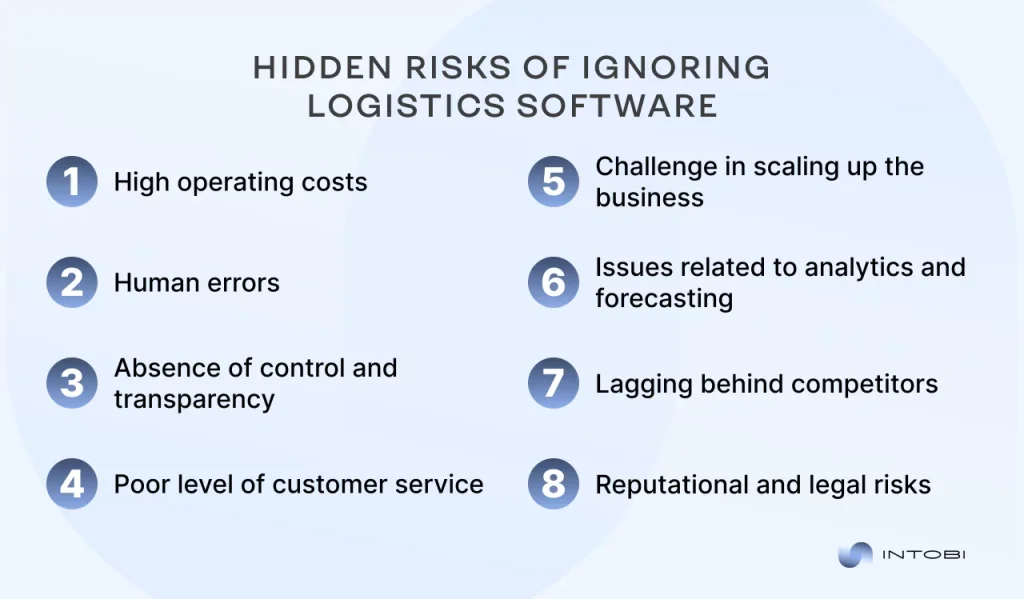
High operating costs
The majority of the processes are conducted manually without automation: route planning, inventory control, and reporting. This results in wastage of time and resources, inefficient use of transport, and warehouses. This leads to an increase in fuel, personnel, and maintenance costs and consequently reduces profitability.
Human errors
Errors are always linked with manual data entry. Mistaken data in invoices, orders that are made twice, or wrong inventory information may have severe repercussions. A single error can lead to huge issues in big corporations that can be prevented under the condition of automation.
Absence of control and transparency
Lack of modern tools in tracking within a business implies that a business loses control of its supply chain. The managers lack access to real-time information, which prevents them from making fast and accurate decisions in case of an issue or delay.
Poor level of customer service
Customers demand precise delivery timelines and the ability to track their orders. These customers turn to competitors if a company fails to be transparent and provide quick responses.
Failure to deliver goods and frequent procrastination create a negative impression that cannot be easily rectified in the future.
Challenge in scaling up the business
Manual processes are a bottleneck as the number of orders and customers grows. A company lacking logistic software will struggle to increase volumes, regardless of speed, leading to chaos and high expenses. This prevents growth and poses a competitive barrier.
Issues related to analytics and forecasting
Without the modern systems, the businesses do not have high-quality data to analyze. Managers lack a clear vision of costs, are unable to predict demand, and struggle to establish the efficiency of carriers. This causes unplanned decisions and missing opportunities.
Lagging behind competitors
As other businesses are applying artificial intelligence, machine learning, and predictive analytics, businesses that do not use logistics software are slowly falling behind. The lag is irreparable because competitors are becoming quicker, more efficient, and less expensive when it comes to taking orders.
Reputational & legal risks
Rules, standards, and requirements should be observed in international logistics. In the absence of logistics enhanced solutions that regulate document circulation and adherence to the law, a company can easily face fines or even be denied the possibility of conducting business in some countries.
In general, the lack of logistics software poses significant risks to businesses across multiple areas, including financial stability, productivity, customer experience, operational capacity, and competitiveness. Modern logistics management solutions allow a company to reduce these risks considerably and provide sustainable development in the future.
Future trends in logistics software
The logistics software is undergoing a transformation – from an operational support tool to a strategic business platform.
With the increasing complexity of supply chains and the rising demands of customers, future logistics software will be less about basic automation and more about intelligence, flexibility, and resilience.
One of the top trends is the increased application of AI and predictive analytics. Logistics networks are increasingly turning to forecasting demand, predicting risks ahead of time, and automatically recommending the best routes, inventory, or supplier swaps. The decision-making process is becoming less human and more data-driven.
Another big change is end-to-end visibility in the supply chain. Expectations are rising for a unified view of transportation, warehousing, suppliers, and inventory.
New logistics systems are tearing down data silos and integrating with ERP, SCM, and third-party systems to deliver real-time visibility instead of piecemeal reporting.

Automation and robotics are also becoming standard, not just opntinal tools. Software is evolving to manage automated warehouses, autonomous vehicles, and smart sorting systems.
The future lies in physical automation that is tightly connected to digital workflows. The main aim of these enhancements is to reduce human error while improving speed and scalability.
Cloud-native and modular architectures – another hot trend. Businesses no longer want rigid, all-in-one systems that are difficult to customize. Instead, they prefer flexible platforms where specific capabilities (TMS or WMS, or analytics) can be added, scaled, or replaced as needs change.
Finally, sustainability and cost efficiency are becoming core software requirements. Future logistics solutions will increasingly include tools to measure emissions, optimize fuel usage, and support greener transportation strategies, driven both by regulations and by customer expectations.
Wrap up
Logistics software set a new dimension of efficiency for companies that are engaged in the sphere of supply and transportation. These solutions enable you to manage important processes within one system, decrease the possibility of mistakes, and minimise the time taken to execute operations.
The role of supply chain and logistics softwaresystems will only increase in the future as the digitalization of logistics will become a standard, without which it is hard to imagine the successful management of supply and the satisfaction of customers.
Get in touch with us, and we will help you to create modern and reliable logistics software that optimize operations and reduce costs.
FAQ
Logistics software is a computerized tool used in business planning, managing, and tracking supply chain operations (such as transport, warehousing, and inventory) to provide quicker yet cost-effective deliveries.
It can automate route planning, reduce fuel expenses, minimize lagging times, and simplify communication, enabling companies to conserve time, minimize expenditures, and enhance dependability in the delivery companies.
Yes. It helps to increase shipment volumes and improve fleet management. It is connected with other systems, which makes it easier to increase operations without losing the speed and quality of the services.
These are transportation planning, inventory control, warehouse management, tracking of orders, and demand forecasting, which are directed towards the efficient movement of goods between the supplier and the customer.
 Facebook
 x.com
x.com
 Linkedin