



Have you already heard much about medical patient management software? We’ll tell you more.
Taking into account that 70% of healthcare organizations report improved efficiency after the adoption of these systems, the topic is more than worth delving into.
Here, we’ll discuss what a patient management system is, take a deeper look at its key features, and examine the many ways it revolutionizes healthcare. We’ll discuss how this software is of immense benefit in the management of appointments, billing solutions, enhanced communication with patients, and even predictive analytics for informed decision-making.
Along the way, we will also discuss the contrast between traditional patient management systems and the innovations of today, as well as challenges in implementation, and provide tips on how to make these solutions work for you.
What is patient management software?
Patient management software is an extended digital solution for the easy management of patient-related data and administrative tasks of any organization in the healthcare sector.
The global market for patient engagement software, according to projections, will reach 58 billion by 2035.

Advanced technology integrates all sorts of functionalities that allow health professionals to access patient information, book appointments, and communicate with patients with ultimate ease on a single platform.
The patient information management software maximizes operational efficiency by significantly reducing paperwork and automating routine processes. It converts an otherwise complicated workflow into something much more manageable, enhancing the patient experience immensely.
With healthcare software development, everything from the patient’s history to treatment plans and demographics is just a click away. The system provides a clear, organized overview of the needs of each patient. In such a way, providers can deliver faster, more personalized care by simplifying information management.
The result is shorter wait times and better use of resources, enabling healthcare organizations to offer higher service quality and increased transparency.
Key ways patient management software revolutionizes healthcare
Patient data management software is the force for change in healthcare, as it allows seamless operations and provides an enhanced experience to the patients.
From smoother management to the other clear benefits of patient management software, this technology simplifies essential tasks and improves the way patient care is delivered. Here are some significant ways it impacts those who embrace it:
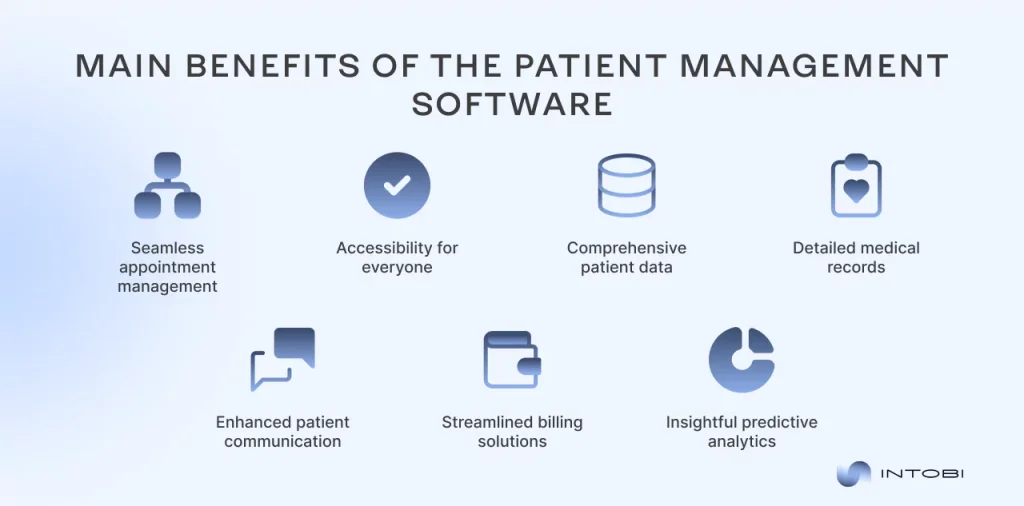
Seamless appointment management
An online patient management system lets appointments be scheduled easily, reducing the chances of errors and freeing the provider to attend to what is most important: patient care. Automated reminders and easy rescheduling options keep everyone on track.
Patients can adhere to their appointments, while providers can optimize their schedules, which leads to a more organized and pleasurable practice.
Accessibility for everyone
A patient management app brings convenience to a whole new level by allowing access to health information with ease from any corner of the earth. The friendliness of the app inspires patients to engage in their own care, such as making an appointment, viewing lab results, and communicating directly with the healthcare team.
For healthcare providers who want to improve patient access and communication, patient portal development can connect appointment scheduling, lab results, and secure messaging in one user-friendly system.
Comprehensive patient data
A patient management system software consolidates all critical patient information in a single platform, allowing each healthcare provider to have a complete perspective and view of every patient’s history. When the treatment provider can access well-organized patient records, they can respond in the best manner and timely manner, leading to positive treatment outcomes.
Detailed medical records
Patient care management software ensures that records of medical concerns are kept accurately.
This precision level is critical to quality care. In this regard, providers have all the relevant information on the patient to monitor their progress much more easily and make changes in treatments where necessary. Continuity of care is also easy because each provider has insight into a patient’s medical history.
Enhanced patient communication
In a world of robust patient management features, communication between patients and providers is much easier. With secure messaging systems and automatic follow-ups, patients are much more conscious and engaged in interaction.
Open lines of communication mean that patients feel more valued and supported, which results in better adherence to treatment plans, improved health outcomes, and an attracted clientele.
For clinics that want to centralize patient relationships and automate follow-ups, CRM development services can help extend these communication workflows into a tailored healthcare CRM.
Streamlined billing solutions
The billing solutions integrated into the patient management systems are among the features that add the most convenience. Automated billing processes reduce errors and clients’ confusion while increasing speed.
This efficiency enhances cash flow and patient satisfaction over billing, hence giving healthcare providers time to address patient care rather than administrative issues.
Insightful predictive analytics
Finally, insightful predictive analytics provide healthcare organizations with valuable data insights that guide future patient software management. Providers can predict any upcoming challenges and take necessary measures in advance.
This foresight brings strategic changes in care, resulting in improved health outcomes and data-driven resource utilization within the organization.
Now, you see that embracing patient management software is a huge relief for both healthcare providers and patients. Let’s compare it with the familiar management systems to observe its impact further.
Comparison with traditional management systems
A modern patient data management system offers an innovative solution that resolves the accumulated pains of medical staff and clients. This comparison explores the key differences between traditional methods and contemporary patient management systems, highlighting how the latter stands out in effectiveness.
| Feature | Traditional patient management systems | Patient management software |
| Data management | Often, paper-based or limited digital data storage | All-inclusive online resource with real-time updates |
| Appointment scheduling | Manual scheduling leading to potential errors | Automated scheduling with reminders and rescheduling options |
| Patient communication | Primarily face-to-face or phone communication | Secure online messaging, automated follow-ups, and notifications |
| Record keeping | Fragmented records stored across various locations | Centralized patient data accessible from anywhere |
| Billing processes | Manual invoicing, prone to errors | Automated billing and payment processing with detailed reports |
| Accessibility | Limited access due to physical records | Anytime, anywhere access through online systems |
| Analytics and reporting | Basic reporting capabilities | Advanced analytics for data-driven decision-making |
The shift from traditional management systems to advanced healthcare management systems is imperative to ensure quality healthcare. This technology enables practitioners to devote more attention to what counts most: providing quality patient care.
Challenges in implementing patient management software
Something new always calls for a bit of anxiety. Implementing patient management software brings significant benefits, but it also comes with challenges that healthcare organizations must overcome.
These are some of the most pressing issues companies could encounter when implementing them, along with solutions.
1. Staff resistance
Resistance from employees to old procedures is one of the main obstacles. Transitioning to new software can be met with hesitation, as employees may feel overwhelmed by the learning curve or concerned about adapting to unfamiliar processes. Fostering a favorable attitude toward the new system requires addressing this opposition through efficient training and communication.
To acquaint the staff with the new system, extensive training sessions and demonstrations will be useful. To allay worries and demonstrate the advantages of the new program, communication should be transparent.
2. Cost and budgeting
Implementing patient management solutions often requires a significant investment in both software and hardware. Organizations must also account for recurring expenses like upkeep, upgrades, and training after the original purchase. Analyze the costs carefully before implementation to identify any and all possible expenses.
3. Data migration
Migrating existing data from traditional systems to new patient management software poses a major challenge. Maintaining continuity of care requires precise data transfer that is free from loss or corruption.
Additionally, integrating the software with other existing systems, such as billing or laboratory software, can complicate the process further and may lead to downtime during the transition.
The strategy for data migration will be well-planned, detailing the steps of migration regarding backup and validation. This calls for IT professionals who will ensure that the data is transferred from the old systems to the new platform with accuracy and efficiency.
4. Compliance and security
Healthcare institutions are subject to stringent laws governing the security and privacy of patient data. Implementing a new patient management system requires careful consideration of compliance with laws such as the Health Insurance Portability and Accountability Act (HIPAA).
Ensuring that the new software meets these regulatory standards while sufficiently protecting sensitive patient information can be a complex task.
Communicate with the compliance and legal departments to make sure the selected software satisfies all legal standards. Periodically audit data security measures and offer training to staff on best practices for maintaining patient confidentiality.
5. Ongoing support
Patient management software needs continuous support after it is put into operation in order to handle user concerns and technical problems. Businesses must be ready for any issues that may arise with software upgrades, system failures, or user issues.
Establishing a reliable support system is crucial to ensure that staff can effectively use the software and that patient care remains uninterrupted.
After implementation, you can hire a specialized support staff to address user inquiries and technical problems. Create a feedback system to make sure staff members are comfortable using the program and to enhance the system continuously.
Patient management software incorporation tips
Apart from the mitigation strategies, there are some very valuable tips that can help you experience fewer hurdles while transitioning to the electronic version of patient entry software.
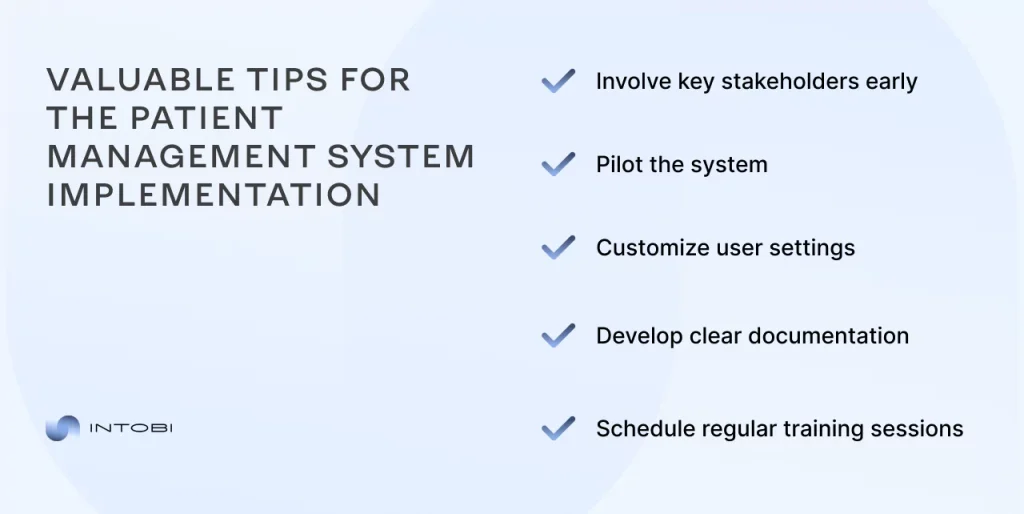
Involve key stakeholders early
Engagement with the team members of every department at an early stage of implementation may bring insights into tailoring the features of the software toward their specific needs. This will make the transition easy and ensure maximum utilization of the patient administration system software.
Pilot the system
Prior to complete implementation, think about conducting a minimum viable product (MVP) with a small user base. This is a testing phase where you can highlight some problems and get feedback, ensuring that the patient entry software works well before releasing it for organization-wide use.
Customize user settings
Leverage the custom options afforded in the patient administration system software to customize user settings and workflows to your current processes for an easier transition by staff. This would minimize the problems that usually arise.
Develop clear documentation
Record detail-oriented procedures and tips throughout the use of new software, thus providing a great reference for your staff. A lot of the confusion often displayed during an adjustment to another system would be assuaged.
Schedule regular training sessions
Even after the initial implementation, plan for ongoing training sessions. The regularly scheduled training will ensure that all staff members are updated on new features and functionalities of the hospital patient management system. g and a focus on collaboration, your team can unlock the full potential of patient management software, achieving improved communication and a brighter future in healthcare.
Future trends in patient management software
We have only just begun to envision the ways in which the patient care management system of the future will transform healthcare. We can expect patient care management systems to become more intuitive, personalized, and integrated than ever before.
Imagine advanced artificial intelligence that can anticipate patient needs by offering tailored healthcare recommendations right at the point of care.
Also, the integration of telehealth functionalities will be seamless, allowing patients to engage their providers of choice from the comfort of their homes. You’ll be able to schedule an appointment with just a few taps on your smartphone or receive a video consultation that feels as personal as being in the office.
This level of accessibility empowers patients, tears down barriers to care, and nurtures deeper relationships with their providers.
These trends will also be fed into the patient management systems by emerging technologies such as wearable devices and mobile applications for health, which collect real-time health data to enhance treatment plans.
As patient care management systems harness this wealth of information, healthcare providers will have unparalleled insight into patient behaviors and trends, enabling improvements in preventive care and better disease management.
With all these developments, skepticism about patient management software can easily turn into excitement. The dream of a leaner, more compassionate, and more efficient healthcare system is not too far away – it is happening now and will change your experience both as a patient and a provider.
Intobi’s expertise in software solutions for healthcare
At Intobi, we are dedicated to delivering software solutions that meet the highest industry standards. Our specialty is turning difficult problems into creative answers that help our clients succeed.
One of our recent projects for the healthcare field is M-NeuroS. It’s a platform with an advanced AI system that helps to deal with many problems in healthcare organizations. M-NeuroS helps to solve issues such as fragmented patient data, delayed risk detection, and operational inefficiencies.
What makes this project unique? This AI-based solution provides actionable information without complicating healthcare workflows.hcare realm.

Challenges we handled
- Fragmented patient data Scattered across multiple systems, limiting visibility into patient histories.
- Delayed risk detection Manual processes identified risks too late.
- Operational inefficiencies Limited real-time insights into staff, beds, and resources.
- Complex data for non-technical users Clinicians needed clear, actionable insights.

Value delivered
- Earlier risk detection AI highlighted potential patient risks 25–35% sooner than manual reviews.
- Improved clinical efficiency Automated summaries cut data review time by 30–40%.
- Better operational visibility Predictive dashboards reduced bottlenecks and improved patient flow.
- Reduced cognitive load Plain-language dashboards helped 78% of users make faster, clearer decisions.
- Higher stakeholder confidence 82% of decision-makers rated insights as “clear and actionable.”
Our work with Neuro-S is a testament to the quality of customized software solutions that Intobi offers to solve real-world challenges, including the challenges in the healthcare realm.
Conclusion
The patient data management software enhances communication between patients and providers by using patient management software.
Automated reminders and notifications ensure that the patients are up to speed and engaged with their care, while providers are able to smoothly operate the workflow through streamlined data management. Therefore, it presents an accessible and efficient healthcare experience.
Such a position makes medical patient management software a vital tool in reshaping the mode of delivering and managing care in the modern health environment. If you need a patient management software or any other kind of software portals development – reach out to us to get the solution that will help your business grow!
FAQ
The patient information management system is an e-solution designed to improve and simplify all healthcare operations. That means health professionals keep patient records, appointments, billings, and all communications on a single platform.
Though the best patient management software might vary with needs, some of the great solutions in the market are those developed by Intobi. Intobi introduces a robust patient management system: scheduling, billing, and communication on one platform.
Electronic health records and patient management software are often the most popular types of software for patient management. The most prominent and well-known brands are Epic, Cerner, and Athenahealth – health companies use them to expand their capabilities in improving care coordination.
The healthcare management system (HMS) helps the organization manage all operations of patient management software in healthcare. It keeps up administrative tasks, organizes patient data, and facilitates better provider-to-provider contact.
 Facebook
 x.com
x.com
 Linkedin