

TL;DR
Launching a product without validated hypotheses drains budget on features nobody uses. This guide explains what an MVP is, why it matters for startups, and walks through the MVP development process step by step – from defining the core problem and prioritizing features to building, testing, and iterating on user feedback. It also covers launch preparation, best practices, common challenges, and real-world examples of MVP development.
Make a summary of this article with AI:

Launching a product without verifiable hypotheses invariably causes a drain on resources. Commonly, startups spend months developing features that have no impact on conversion or user retention. All of this happens because of a lack of validation before scaling.
MVP development incrementally rearranges this setup to break the cycle of building without validating. The team tests a specific business hypothesis endowed with minimal functionality by means of assessing user interaction with the product. This provides measurable data on what gets dropped off, what is ignored, and what works.
This article explains a step-by-step model of MVP development, from problem formulation to post-launch metric analysis, and presents MVP as a solution that impacts the product and the business.
MVP changes the sequence of actions: first, you validate the value, and only then do you scale up. This reversal helps avoid situations where the product is technically ready, but the market doesn’t need it.
What Is an MVP and Why It Matters for Startups
In a competitive environment, launching a full-fledged product without testing your hypotheses leads to a low-reward scenario of eventual cost overruns and delays. The MVP development process validates product ideas with minimal investment and faster time-to-market, giving startups a distinct advantage.
At this stage, it becomes clear whether there is demand for the product and whether users would be willing to pay for it. The MVP stage of startup protects businesses by minimizing risks while exploring product-market fit.
Definition of Minimum Viable Product
A Minimum Viable Product (MVP) is a general reference to a product’s basic version with a minimal set of features sufficient to solve a key user problem. The term has been coined and popularized by Eric Ries (author, entrepreneur, and author of The Lean Startup), and nowadays, tech startups regard it as a baseline.
The Role of MVP in the MVP Stage of Startup
The MVP stage of startup involves testing assumptions before scaling product development further, which is critical to achieving the desired outcome efficiently. At this point, scalability takes a back seat. The focus shifts to user experience: which features work best, which of them users are actually using, where they run into problems, and what they find most valuable.
Key Benefits of the MVP Development Process
The MVP development process is designed to deliver singularly the essential features to solve core user problems. This is advantageous in many ways:
- quicker market entry;
- cost saving;
- reduced risk of failure;
- real-world feedback;
- the capacity and resilience for rapid changes.
This way, the business receives a consistent model for user interaction. This does the spadework for scaling that is based on data.
Speed is by no means an end in itself, but a tool for gathering feedback from the market.
Interesting
The sooner the team receives this feedback, the less costly each mistake gets, and the faster they can develop a product that’s actually in demand.
- For this approach to work, it is important to understand the value of an MVP and to optimize the process of creating it. This determines how quickly a team can move from an idea to a proven solution.
TRUST AN EXPERT TEAM WITH YOUR MVP
Contact us
Understanding the MVP Development Process
The MVP development process advocates and enables continuous iteration based on real user feedback and analytics. The corresponding procedures are cyclic and are specifically as follows: development→testing→enhancement.
An MVP is a closed-loop process in which each iteration builds on the previous one. Gradually, it reduces uncertainty and propels well-informed decision-making.
What Is the Minimum Viable Product Development Process?
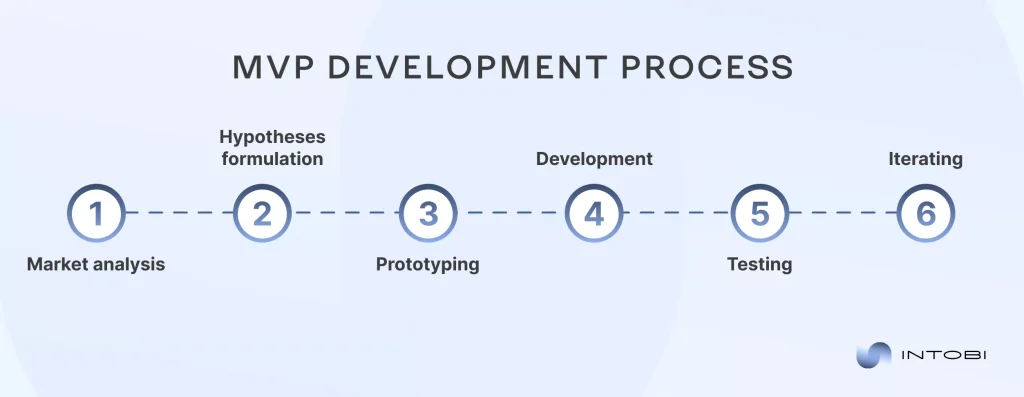
The minimum viable product development process entails research, prototyping, development, and testing. Such a comprehensive and structured approach prevents haphazardness and unites the team around a common goal. Key phases include (exclusively in that order):
- Market analysis
- Hypotheses formulation
- Prototyping
- Development
- Testing
- Iterating
In this sequence, each stage logically reinforces the next and eliminates doubt before moving forward. Thus, project teams can systemically and sustainably proceed from hypothesis to proven solution.
How the MVP Process for Startups Differs from Traditional Development
The minimum viable product development process contrasts with full-scale development as it holds speed and validation above all. The MVP process for startups favors learning and validation over feature completeness.
Traditional development suggests:
- longer release cycles;
- larger budgets;
- aiming for the spot-on final result.
MVP logic tolerates:
- short sprints;
- minimal functionality preparation;
- prompt hypotheses testing.
These approaches differ primarily in their decision-making logic. An MVP can mitigate hazards through rapid validation, whereas the traditional model attempts to eliminate them before products or services get marketed.
Core Principles of a Successful MVP Development Process
The minimum viable product development process pivots on efficient resource allocation in the early stages. Key principles include:
- emphasis on value;
- speed means more than perfection;
- data takes precedence over assumptions;
- flexibility in decision-making.
Every decision has a tangible impact on the product and business outcomes. Understanding exactly which factors are at play allows the team to allocate resources frugally and to systematically work toward validating key hypotheses.
These principles mean a strict hierarchy is at play: every feature, every sprint, and every decision must answer the question of whether or not they bring a project closer to validating the key hypotheses. If not, the task gets postponed or rejected.
Step-by-Step MVP Development Process for Startups
Once the principles have been established, they ought to be put into practice. Even the most effective approach loses its impact without a clear sequence of steps and becomes a random set of decisions.
Step MVP development process for startups provides a clear, actionable roadmap from idea validation to product launch.
MVP is also a practical tool that breaks down a complex process into clearly defined steps, each with specific deliverables. Thus, teams can work in sync, monitor progress, and make timely adjustments based on the data collected.
Step 1: Identify the Problem and Target Audience
MVP makes no sense without a solid understanding of the problem. It is therefore crucial to:
- identify pain points;
- segment the audience;
- establish user personas.
At this stage, it is crucial to avoid a common mistake: framing the problem from within the business rather than from the user’s perspective. Interviews with potential customers, competitor analysis, and behavioral pattern analysis point to actual and urgent necessities.
Step 2: Define Core Features and Value Proposition
Focus on identifying the solution that directly addresses the core user problem. For instance, the MVP in Uber’s case is booking a ride, whereas Airbnb aims to simplify the booking of accommodation.
The value proposition must be formulated in a way that allows validation through a specific user action, such as registration, subscription, payment, or another meaningful interaction. If value cannot be measured, it cannot be validated.
Step 3: Create a Prototype or Wireframe
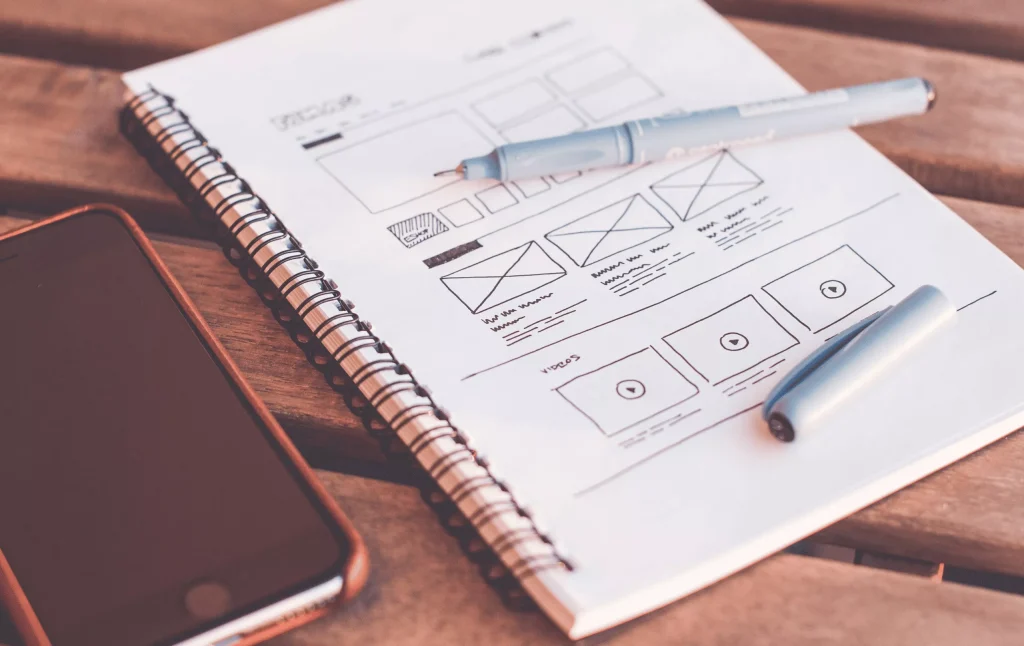
A wireframe is a static framework, a layout of elements (low-precision), whereas a prototype is a clickable, interactive model that simulates the actual operation of the product (detail-oriented). Wireframes outline and display the structure, while prototypes mirror the user experience (UX).
Prototyping allows you to detect UX issues before the development phase even begins: complex navigation, unclear user flows, or cluttered interfaces. It is much cheaper to fix these issues at the prototype stage than after release. It is, by all means, advisable to call in a favor of professional product design specialists.
Step 4: Develop the MVP Product
At this stage, a workable solution is produced. Key considerations:
- use a reliable tech stack;
- avoid overengineering;
- build a scalable architecture.
Speed and quality require a controlled trade-off: technical debt can be tolerated only if it does not block future iterations. The architecture must support at least basic scalability.
Step 5: Test and Gather User Feedback
Actual users are by far the most credible source of information and truthful feedback. Essential metrics include:
- retention rates;
- conversion rates;
- user behavior.
User behavior is an umbrella term for a string of quantitative and qualitative data pointing to how users interact with a website. These encompass:
- bounce rates;
- click-through rates;
- conversion rates;
- exit rates;
- page views/page(s) per session;
- rage clicks;
- scroll depths;
- session durations.
Quantitative metrics show what is happening, while qualitative ones explain why it is happening. Therefore, qualitative feedback (interviews, usability tests, session recordings) warrants closer scrutiny.
Step 6: Iterate and Improve
An MVP marks the beginning of a product’s journey. Iterations are based on:
- analytics;
- feedback;
- business goals.
Iterations gain value when each hypothesis is isolated and followed by a dedicated test. When multiple variables change simultaneously, attributing outcomes to a specific factor becomes unreliable, as causal relationships can no longer be clearly identified.
Don’t play dice with the market
Get in touch
MVP Development Steps Explained in Detail
MVP development steps bring order and structure to the product creation process by splitting it into manageable phases. Breaking down the steps makes the MVP development process more manageable. The more clearly defined the stages are, the easier it is to identify bottlenecks and adjust the approach.
Prioritizing Features for Faster MVP Launch
Prioritization is key to planning and executing procedures related to MVP development. The integral methods include:
- MoSCoW method (must/should/could/won’t), to urge early delivery of critical features;
- value vs effort dichotomy explication, to maximize output through ROI and yield the highest impact with available resources;
- Kano model, to organize product features based on how they affect user satisfaction.
Choosing the Right Technology Stack
Optimal selection of an appropriate technology stack accounts for:
- product type;
- budget;
- scaling requirements.
Standard options include, but are not limited to:
- Frontend: React, Vue;
- Backend: Node.js, Python;
- Cloud: AWS, Azure.
Apart from the basic criteria, it’s important to consider development speed and the availability of developers. The chosen tech stack should meet project requirements and allow for rapid team scaling.
Building a Scalable MVP
MVP is by no means a one-time product. As a concept, it concurs that the architecture of a digital product should allow for scaling without a complete rewrite. Scalability at the MVP level anticipates and, therefore, relies on the predictability of essential modifications. The codebase should support the addition of new features while leaving existing modules untouched.
Preparing for a Successful MVP Launch
MVP launch most certainly ought to be considered a data-collecting phase rather than a final product release. Once development is complete, the quality of the preparation leading up to it still matters. This stage determines the utility of the resulting data.
Pre-Launch Checklist for Startups
Before the procedures for a final product release commence, be sure to:
- test functionality;
- conduct basic analytics;
- onboard users;
- secure technical stability.
Setting up analytics tools (such as Google Analytics, Hotjar, or Mixpanel) and defining key metrics before launch ensures that collected data remains structured and actionable. Without this preparation, the resulting data is often fragmented and offers limited practical value.
Common Mistakes to Avoid Before MVP Launch
Typical missteps in MVP planning revolve around:
- feature overload;
- lack of clear value;
- neglecting UX;
- launching without testing.
How to Measure Success After MVP Launch
Key metrics to track after launch:
- customer acquisition cost (САС);
- lifetime value (LTV);
- churn rate;
- engagement.
When evaluating MVP performance results, it is important to consider both the absolute values of the metrics and their trends. For example, an increase in retention, even when the current values are low, may indicate that the product is heading in the right direction.
READY TO BUILD A SMARTER MVP?
Speak to us
Best Practices for the MVP Process for Startups
Aligning MVP with Business Goals
MVP development steps should always complement both user needs and business goals. MVP ought to serve the goal of tackling business objectives and technical aspects alike.
Using Agile in MVP Development Steps
Agile is an iterative and collaborative approach to software development, designed to deliver working increments of software bit by bit and successively rather than all at once. In MVP development, Agile provides for:
- swift adaptation;
- consistent work in iterations;
- gradual and sustainable mitigation of risks.
Leveraging User Feedback Effectively
Feedback is where every interaction’s purpose truly lies, which is especially true about software development and SaaS solutions in particular.
Meaningful feedback (i.e., the one that makes sense) is:
- regular;
- structured;
- measurable.
Priority should be given to recurring signals affecting key metrics.
Common Challenges in the MVP Development Process

Overbuilding the Product
Adding unnecessary features is a common mistake. This slows down startup and increases costs.
Ignoring Market Validation
Validation is what elevates a product to the status of a business.
Budget and Time Constraints
Constraints can do good, especially when it comes to unlocking a product’s potential when the entire niche is stagnant. This explains why the MVP approach works: it urges you to keep functioning under uncertainty.
VALIDATE YOUR MVP IDEA WITH EXPERTS
Connect with us
Real-World Examples of MVP Development
Successful MVP Case Studies
Dropbox has organically embedded a video demo rather than a finished product. Airbnb prides in being a straightforward rental website. Uber has taken the quality of ride-hailing functionalities to the next level, setting the bar really high for those who follow. What these three companies have in common is that they chose not to build complex systems right away, but tested the market instead.
Lessons Learned from Failed MVPs
Most MVPs fail because they:
- defined the scope incorrectly;
- neglected system structure;
- used incorrect metrics;
- were oblivious/uncomprehending of user feedback;
- misaligned with the target audience;
- lacked a proper marketing strategy;
- solved non-existent problems (proved irrelevant/redundant).
Most setbacks emanate from scaling too soon, when a team invests in marketing or infrastructure before the product’s core value receives its validation.
Conclusion: Mastering the MVP Development Process for Startup Success

MVP development is how strategic thinking manifests itself. As a method, it:
- reduces risks;
- optimizes expenses;
- builds a product based on real data.
Companies that systematically work with data and hypotheses form a competitive advantage in the accuracy of their decisions.
If you require a team to guide you through MVP development from ideation to product launch, feel free to reach out to us.
FAQ
How to build an MVP?
What are the stages of MVP development?
What is an MVP development plan?