



If you own a commodity business or are involved in such activities, you have heard of logistics transportation. Logisticians usually deal with transportation management solutions manually: searching for trucks, planes, and barges that can take goods in whole or in part. This approach becomes especially challenging without precise control over the process.
However, don’t worry if you find yourself in a similar situation. A special “pill” has long been invented that can solve logistics challenges, bringing transparency, cost efficiency, automation, and full control to transportation operations.
The topic of this article is about this “pill” named TMS or transportation management system. But what is TMS in logistics? Today, we will talk about individual transportation management systems and how they help solve logistics problems for B2B (business-to-business).
What exactly is a TMS transportation management system?
We are sure you have encountered such a problem as human error at work. Mistakes in numbers, incorrect reports, and fake presentations. And, most painfully for every entrepreneur, all this means a loss of potential profit. Moreover, this applies to any field. You have to admit, it’s quite annoying, isn’t it?
Freight transport management systems or TMS software are a savior to most firms. Don’t mix it with CRM or ERP: TMS system operates on the logistics level, once the customer has made an order, but before the delivery.
- CRM (customer relationship management) system focuses on customers and orders before the purchase.
- ERP (enterprise resource planning) system manages internal resources, finance, and operations.
- TMS transportation management system is between order confirmation and delivery. This system is used to manage carriers, routes, costs, and timelines.
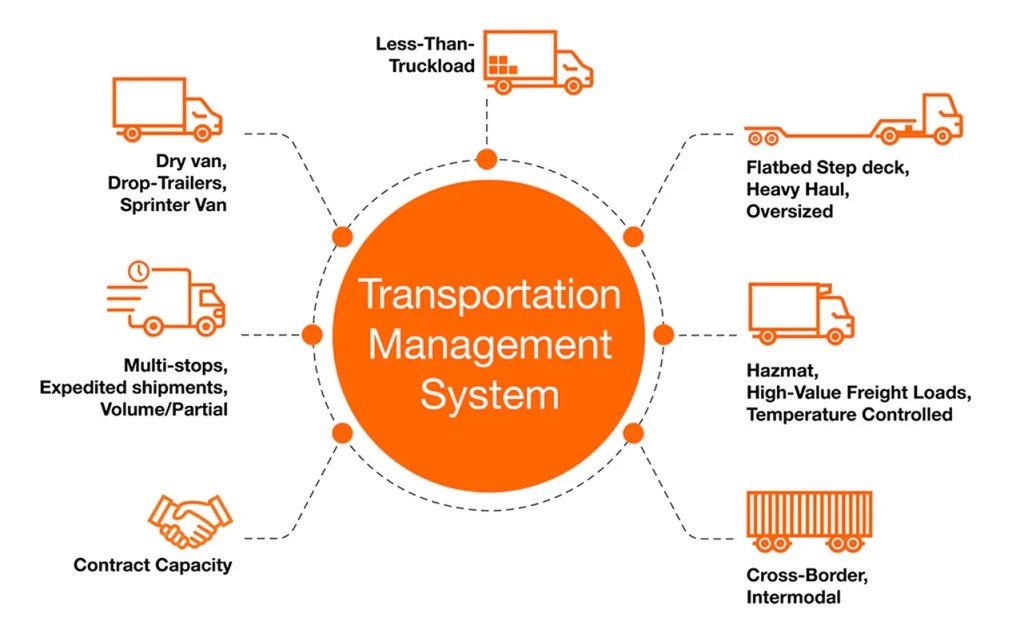
In the transportation field, curious situations like this happen. A truck arrives to pick up goods from the warehouse, but it can only hold 60% of what the paperwork indicates should fit. Why does this happen?
The manager or driver mixed up the dimensions, and instead of the stated 1.2 m length of the part, they marked only one meter. That is, according to the documentation, 150 parts should fit, but in fact, not even a hundred fit. So, just 20 cm breaks the whole scheme of all other additional loads.
This is a consequence of human work. No, this does not mean that logisticians, managers, and drivers have suddenly become public enemy number one. It is a simple fact that people make more mistakes than the TMS transport management system. Let’s take a closer look at the work and functions of these systems.
Features of TMS system that save money
Manual logistics operations can be quite costly. A transportation management system software helps to automate important logistics operations. It minimizes chances of errors, and ensures that every shipment is optimized. Here are the features that can help in cost savings in transportation management systems.
- Automated carrier selection
Choose the most cost-effective carriers based on rates, capacity, and reliability. - Route optimization
Plan the shortest and fastest routes to cut fuel costs and transit times. - Freight cost comparison
Easily compare prices across carriers and transportation modes. - Load consolidation
Combine shipments to avoid paying for unused space. - Real-time shipment tracking
Prevent delays, missed deliveries, and penalty fees. - Data-driven analytics and reporting
Identify inefficiencies and areas for cost reduction.
How TMS streamlines your logistics
TMS management systems address numerous issues related to both sea and land transportation. But what is the point? This is how your conservative manager, who is used to standard tables, might respond. Is it really so popular that it is impossible to do without innovations?
In 2024, the global transportation management system TMS market was worth $15.88 billion. It is expected to expand at a 17.5 percent rate between 2025 and 2030.
The developments driving the global TMS management system industry’s expansion include the growth of the retail and e-commerce sectors, technological advancements, the introduction of new solutions to the market, and the improvement of trade relationships among nations worldwide.
The TMS is also required when manual accounting and Excel have outgrown their usefulness. Take, for example, a company that receives dozens or hundreds of transport requests per day, with complicated routes, a couple of warehouses, and dozens of carriers.
Without centralization, everything begins to slip through their fingers. If the cargo is lost or the documents are not delivered, a customer calls, and the operator does not know where the vehicle is. All this is normal mayhem prior to TMS implementation.
The point of the system is to provide logisticians with a tool that presents them with the entire picture: what, where, when, by whom, and under what conditions it is being transported.
With the transport management solution that may be developed by Intobi, you can make requests, choose carriers, compose routes, track performance, gather documents and invoices, do analytics, and inform all the participants of the transportation process within one window.
TMS management minimizes the human error percentage, accelerates the order processing, and generates actual savings within the logistics.
The logistics is much easier with TMS functionality
An operator receives an order to transport cargo from Chicago to Portland. Previously, it involved opening a spreadsheet, contacting the carrier, manually entering the route, taking the route to the driver in person, and signing paper documents, all while hoping that everything would go through.

Everything is different with TMS. The operator adds the request to the system, or it comes automatically through an API (application programming interface) or CRM connection. The system is filled with immediate entries concerning such parameters as weight, dimensions, the nature of the cargo, and the loading/ unloading points.
The logistics specialist will then select a carrier from the list of contractors. TMS platform: the history is dragged up; who shipped what when, at what rate, and with what lateness. It is not necessary to call and make a request; everything can be done in several clicks.
The request appears to the driver. It is on the mobile application or web browser. The driver confirms it. Thereafter, he/she is given the route and other documents.
The system automatically marks the statuses in transportation:
- “departed”;
- “arrived”;
- “delivered”.
Certain TMS logistics are connected to GPS or utilize the information provided by trackers. This enables logistics experts and customers to track the cargo’s position in real-time. People no longer have to make calls to inquire about the location of their goods; everyone can see it by looking at the system.
Similar technological solutions are also used in consumer delivery services, such as food delivery apps. After delivery is complete, you have the option to automatically generate a report, scan and upload documents, issue an invoice, and save the route to your history.
The customer also receives a notification, allowing them to provide feedback about the driver or carrier, which helps inform future contractor selections. The given process does not entail continual managerial control, and this is the primary advantage of transportation with TMS.
Types of transportation management systems
Transportation management systems come in different forms, each designed to meet the specific needs of a business.
- On-premise TMS is deployed on your IT infrastructure: servers are placed in your office, and data is under your control. You sometimes have complicated logistics, your own certification or regulations, and then a local solution is the only possibility.
- Cloud-based or SaaS This is the form of TMS that operates via a browser or app: the vendor takes care of the infrastructure, upgrades, and security. The system will automatically upgrade itself, and operations will continue as normal.
- ERP with integrated TMS modules The flexibility and integration capabilities are not the greatest, yet there is no manual effort to “glue” a dozen programs together.
- SMB (small and medium-sized businesses) SaaS solutions Core features: tracking, rates, carrier acceptance, CRM / WMS integration. Their benefit lies in the fact that they can be put into effect within a few days and become effective instantly.
Let’s consider the brief table summarizing the pros and cons of each TMS type.
| TMS type | Advantages | Disadvantages | Best suited for |
| On-Premise TMS | Full control, advanced customization, strong security | High cost, requires in-house IT support | Large enterprises with complex logistics |
| Cloud-based / SaaS | Quick deployment, scalable, cost-effective | Subscription-based, potential internet dependency | Growing SMBs |
| Integrated ERP module | Unified system, synchronized data | Limited flexibility, requires an existing ERP | Companies already using ERP |
| SaaS for SMBs | Simple solution with minimal setup | Limited functionality, unsuitable for complex operations | Small businesses with simple delivery routes |
Does your business need a TMS?
Once spreadsheets or disparate systems become inadequate to your growing business, it is time to explore TMS. What tells you that your business needs a revolution?
- A great number of orders When daily orders are 100-200 or more, and employees waste hours planning the routes manually.
- The routing needs are complicated Stops on the way, different modes of transportation, and international deliveries. Manual coordination is subject to error.
- Tracking and documentation problems Constant telephone calls with the question “where is my order?”, misplaced paperwork, or missed delivery times.
- Carrier management issues Carrier management becomes cumbersome when dealing with many carriers and negotiating rates.
Recognize yourself? That’s why TMS is a must for reliable growth and operational control.
The right TMS: Considerations and possibilities
Can a TMS operate completely on its own? In reality, no system can replace human planning entirely. Even with automation, logistics still require oversight, decision-making, and proper setup. The effectiveness of your TMS in 2026 will depend on how it is integrated, which processes it supports, and the quality of the data and management behind it.
Integration with other business systems
In a vacuum, transportation management refers to a collection of systems that track the product as it travels to the client. Is this actually true? To accomplish this, let’s examine in the table below the major components that every trucker is familiar with.
| Logistics steps | Checkpoints |
| Warehouse | Product receiving, percentage of defects, balances, expiration dates, surplus, checking labels, writing off goods. |
| Transportation | Traffic congestion, communication delays, loading, unloading, refueling, changing tires, and changing the route. |
| Client | Final checking, possible detection of external damage, reconciling quantity and quality with documentation, and analyzing the condition of the cargo after delivery. |
It’s difficult to conceive how many spaces had to be rented 100 years ago to hold all the bills. Their reconciliation may have been terrible. In the twenty-first century, the automation of business activities has consolidated data flows into a single system – CRM.
The WMS system, which uses RFID tags, sensors, or other location tracking technologies, offers you real-time information about stock as it moves into, around, and beyond the warehouse. The ERP system’s flexibility enables easy integration with a diverse range of software products via connectors or bespoke adapters, such as APIs.
Other ERP integration solutions incorporate Enterprise Service Bus (ESB) and an Integration Platform as a Service (iPaaS). Transportation management can be merged entirely into the CRM, ERP system, or as a modular solution in the CRM that runs alongside the WMS database.
The future of TMS
The industry of transport management software development suffers from substantial transformation, altering logistics and supply chain management. An imperative trend is the growing adoption of cloud-based technologies.
According to GM Insights statistics, the transportation management market is expected to rise at a 9.9% CAGR between 2024 and 2032. The acceleration of e-commerce has resulted in higher shipping volumes, demanding sophisticated transportation management systems for efficient logistics management.

Companies are migrating from on-premise systems to cloud TMS responses, which provide greater flexibility, scalability, and reduced IT costs. These cloud solutions allow businesses to streamline operations and provide remote access, resulting in better collaboration across teams and geographies.
Geolocation devices and real-time monitoring are being used to facilitate management. Furthermore, huge trucks used for intercity transportation (such as rolled metal) are outfitted with tracking equipment on both the truck and the cargo.
The widespread deployment of AI has resulted in the maturation of TMS into an intelligent management system (IMS). Dedicated Short Range Communication (DSRC) is the “firstborn” that communicates using Wi-Fi at 5.9 GHz. DSRC does not currently support instant connection and request processing, which is required for corporate needs.
CV2X is an updated technology that integrates cellular networks, including 5G, to supply an even wider ecosystem. However, it is still insufficient to serve an extensive array of consumers. This is where AI/VR comes in, TMS integration, such as autonomous CAD models, mobile SaaS servicing, Tesla’s “Fleet Learning”, and AI PriceOptimizer.
Stay on track with Intobi
Intobi is a development team with whom unknown paths will become routes on the map, complete with all necessary marks! We rely on robust technologies such as PHP, ReactJS, Node.js, and C# to build reliable, scalable digital solutions that are ready for real-world logistics challenges.
Case study: Auto Nagel

Challenge: Auto Nagel, an automotive industry leader, needed a logistics-focused SaaS platform to streamline eCommerce, driver management, and document workflows.
Our solution: We developed modules for logistics and driver tracking, integrated eCommerce functionality, user roles, built-in accounting, and a flexible document designer.
Results: Operations became more efficient, document errors decreased, driver management improved, and business processes were seamlessly integrated. And all this thanks to a logistics-first approach.

Final words
Transportation management systems are no longer a luxury but an absolute need for efficiency, cost-effectiveness, and transparency in business logistics. TMS streamlines processes by automating them, consolidates the control points, and provides real-time visibility to the organization to reduce errors, optimize routes, and make informed decisions.
Regardless of whether one has to manage a handful of shipments or hundreds every day, the right transport management software transforms logistics from being a manual nightmare into an automated, data-intensive function.
If you’re ready to discuss a tailored solution for your logistics or transport business, contact us. Our team is here to take your project from planning to production, without downtime or detours.
FAQ
It helps a company effectively manage all aspects of transport logistics, from planning to execution. Intobi’s products automate processes, optimize routes, reduce costs, and boost control over cargo movement.
The price depends on the level of functionality. For small businesses, the cost might start at $15,000. For major organizations creating with broad networks, up to $30,000 or more. Contact us and you’ll know the cost of development.
TMS focuses on route planning and shipment tracking. EDI automates the interchange of business documents between multiple systems, such as purchase orders and invoices, leading to fewer errors. Intobi’s developers can combine TMS with EDI if you need both functions.
 Facebook
 x.com
x.com
 Linkedin